
Bearish bets in the ownership layer corrupt price discovery: A case for DeFi
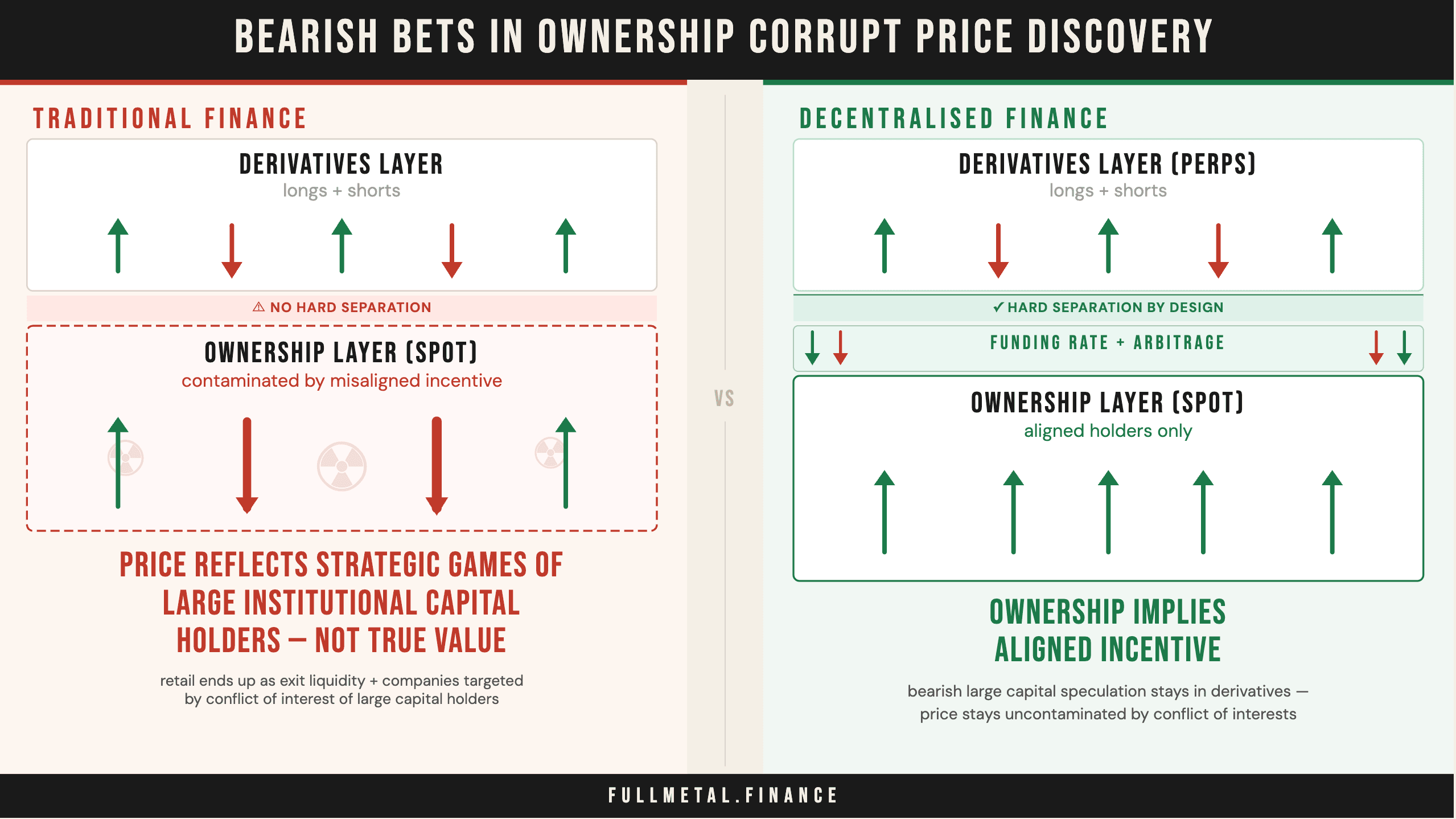
Originally shared on LinkedIn, May 25, 2026.
🤝 Ownership should always imply aligned incentives. This is so obvious — and yet it is the most violated principle in how traditional financial markets are actually designed.
When you own something in the real world, it's because you believe in its value. You have skin in the game, pointed in the right direction. 📈
Short selling has no real-world analogue
The entire logic of short selling in traditional finance — borrowing an asset with unbounded phantom supply, selling it in the market, betting on its failure, buying it back cheaper — cannot be mapped to any coherent real-world analogue. It is simply messy greed retrofitted with an academic justification of "better price discovery."
On paper, short selling sounds game-theoretically sound, because the bears get a means to express corrective sentiment.
In practice, "corrective sentiment" is institutional gamesmanship
⚠️ The problem is that institutional players dominate short positions, with access to information, capital, and coordination that retail investors simply do not have.
So what gets labelled as "corrective sentiment" is often institutional parties playing strategic games with each other — and retail ends up as exit liquidity. Companies get targeted. And when the system is pushed to the edge, everyone gets surprised when the math that was never supposed to add up… actually doesn't.
TradFi was patched, never rebuilt
TradFi never fixed these messes because it was built incrementally. Ugly, convoluted regulations were retroactively patched on after each crisis, and the system was never rebuilt from first principles.
DeFi has no such luxury: lower liquidity means bad mechanism design breaks immediately and publicly, on the blockchain.
That constraint is a feature. It creates an incentive to ensure large capital holders can't silently corrupt protocol logic. Since everything has to be expressed in code, and not bureaucratic policy, the problem is fixed through honest innovation rather than unnecessary and exclusionary complexity.
The separation DeFi makes possible
What's thus emerged in DeFi is a cleaner separation in how primitives function:
- The perpetual futures (derivatives) layer carries speculative and corrective sentiment.
- The spot layer reflects ownership.
Perpetual trends get priced into the spot through funding rates and arbitrage — without anyone who wants an asset to fail ever touching the ownership layer.
Ownership implies aligned incentive. Bearish large-capital speculation stays in derivatives, and price discovery stays uncontaminated by conflicts of interest. ✅